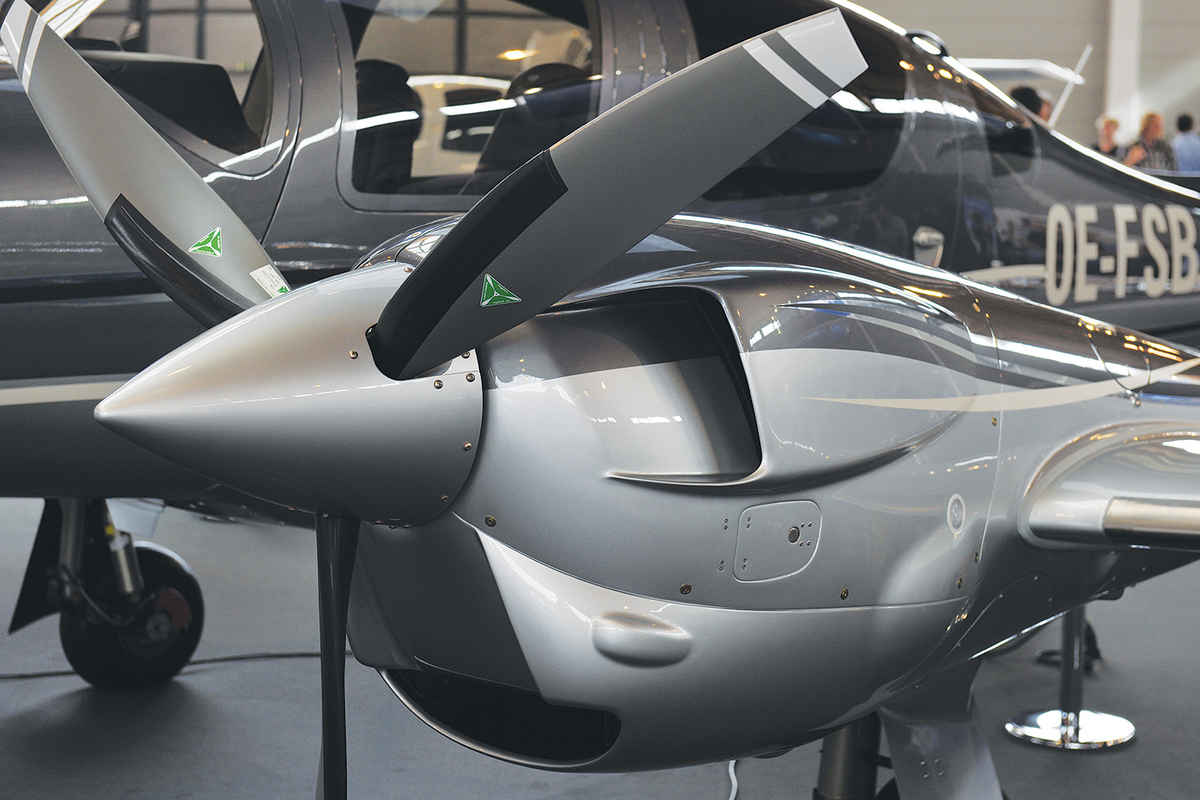
Quest Aircraft delivered 30 Kodiak turboprop singles last year, posting its strongest year since certifying the utility airplane in 2007.
Last year also saw the Sandpoint, Idaho, start-up manufacturer achieve several milestones, including the certification of a new interior, new avionics, FAA approval for a TKS Tank installation in the Kodiak's cargo pod, and an increase in the airplane's landing weight.
"We continue to enhance the Kodiak as well as offer new options based on our own market knowledge and the feedback our customers provide," said Steve Zinda, Vice President of Sales and Marketing. "The enhancements we made in 2014 provide Kodiak operators with even more reliability and versatility, and we continue to work to provide additional performance and feature upgrades that appeal to a broad range of users."
In September, Quest received FAA approval for the integration of the Garmin GFC 700 Automatic Flight Control System (AFCS) in the G1000-equipped Kodiak. Earlier in the year, the company received certification of the new Summit Executive interior. The top-of-the-line five-place interior features club seating, two fold-out tables and two easy-access storage cabinets.
The Kodiak can seat up to 10 in its utility interior. Powered by a Pratt & Whitney Canada PT6, the STOL airplane is capable of taking off in under 1,000 feet and climbing 1,300 feet per minute.
According: flyingmag.com
The Seeker, a light utility airplane born in Australia in the early 1990s, has gained U.S. type certification allowing it to finally go on sale here in America.
If you've never heard of the Seeker you're probably not alone. A two-seat, high-wing taildragger with the engine mounted high behind the cabin, it's an odd bird. In Australia it's long been known as the Seabird Seeker, built and sold by Seabird Aviation Australia.
With exceptional visibility and penny-pinching economics, it's billed as a cost-effective alternative to a helicopter. And if you don't need vertical takeoff and landing capability, there's an argument to be made that the Seeker is just about the perfect alternative to a rotorcraft.
Seekers have been flying in limited numbers in the United States as sales demonstrators and with government entities, and now you too can own one after Seeker Aircraft America completed FAA validation flights allowing them to be shipped here, reassembled and sold as Part 23 certified airplanes.
Two versions will be offered in the U.S. market, the Seeker SB7L-360A and higher horsepower SB7L-360A2, both powered by Lycoming IO-360 engines.
With nearly seven hours of flight endurance and a stall speed of 48 knots, Seeker Aircraft America is hopeful this unique airplane can find a ready home in this country.
According: flyingmag.com
Cubcrafters has started delivering Aerocet's Model 1500 amphibious floats for its popular Carbon Cub series of airplanes. For under $50,000 you too can enjoy flying in and out of lakes and ocean inlets. The carbon fiber floats are available for the factory produced Carbon Cub SS and Sport Cub S2 LSAs, and the experimental Carbon Cub EX, all of which share the same fuselage design.
In addition to water, the amphibious floats allow for landings on unimproved surfaces through its oleo shock system, which features trailing link gear. The gear is retracted through a dual-action hydraulic hand pump.
The floats add 245 lbs to the empty weight of the airplanes. As a result, the SS and S2 will have a useful load of 280 lbs with the floats installed due to the 1,430-lb amphibious LSA weight limit. As the experimental version of the Carbon Cub, which is not limited by the LSA limits, it will have a 700-lb useful load with a significantly greater gross weight of 1,865 lbs.
While no performance figures are available in flight, John Whitish said the cruise speeds of the float-equipped Carbon Cub is about the same or slightly faster as one with 26-inch tundra tires.
Ground handling with the new floats appears to be satisfactory, to say the least. Scot Warren, the principal at Warren Aircraft, reported back to Cubcrafters after trying out the AErocets on his Carbon Cub. "The Aerocets are very solid and user friendly,” Warren said. "Getting on step is a non-issue except you are almost flying before you get there. No real tendency to porpoise. Outside float stays high and does not seem to want to bury during plow turns.”
The cost for the floats themselves is $42,990. Cubcrafters will install the Aerocets for a total cost of $49,990.
According: flyingmag.com
Cirrus SR22 owners can now upgrade their performance capabilities by replacing their metal propellers with Hartzell's three-blade composite prop. The replacement is made with Hartzell's second-generation Advance Structural Composite (ASC-II) construction, consisting of carbon fiber laminates integrated into a co-molded stainless steel shank. A nickel erosion shield protects the outboard half of the leading edge of each blade.
Hartzell's composite prop is currently being delivered to Cirrus SR22T customers taking delivery of their new airplanes. However, the three-blade metal prop is still the standard for the non-turbocharged SR22.
The propeller conversion is available through Hartzell's Top Prop conversion program for $23,943. With anti-ice boots added the cost is $24,249.
While no specific performance numbers are available, Hartzell claims there are many benefits to upgrading to the ASC-II prop.
"Generally, performance benefits available through the Top Prop program include reduced weight, shorter takeoff distance, lower noise levels, better ground clearance, reduced tip erosion, increased climb rate, increased cruise speed and smoother operation," said Joe Brown, president at Hartzell Propeller.
According: flyingmag.com
Yakima, Washington-based CubCrafters announced a new Carbon Cub version at the Sun 'n Fun International Fly-In and Expo this week, improving upon the amateur-built airplane's already impressive backcountry capabilities. The addition of what the company has termed the G-Series ailerons, flaps and tail feathers improves controllability, reduces the stall speed and provides greater trim authority.
The controllability and control harmony of Carbon Cub EX-2 were improved through its newly designed ailerons, which produce "markedly lighter and crisper roll response compared to legacy aircraft," CubCrafters said.
The G-series' slotted flaps, a first for the Carbon Cub, reduce the stall speed and hence the short field capabilities of the airplane. And EX-2 pilots are sure to enjoy the availability of more trim authority when operating near the forward or aft limits of the center of gravity envelope. CubCrafters achieved this through adjustable elevator stops, which provide greater down-elevator trim.
"Together, the G-Series control surfaces improve the overall responsiveness of the aircraft, and provide an appreciable improvement in control harmony," said CubCrafters' CEO Jim Richmond. "Experienced Cub pilots will be impressed."
According: flyingmag.com
Diamond Aircraft's DA62 diesel twin will make its North American debut later this month at the NBAA Convention in Las Vegas, where the Austrian light plane maker is also planning a "relaunch" party of sorts for the brand after a few relatively quiet years with a somewhat diminished U.S. profile.
That's all changing with the seven-seat DA62, a drop-dead-gorgeous, 200-knot speedster that has been tailor-made for U.S. buyers as a step-up product from high-end piston singles.
Diamond has eschewed having a major presence at U.S. shows ever since the demise of its D-Jet single-engine jet project, which led to layoffs at the company's facility in London, Ontario.
Now Diamond says the time is right for a major North American market expansion. The company is rolling out new financing, service and support options for North American buyers, as well as a new Diamond certified pre-owned program. At NBAA, Diamond will also display the diesel DA40NG Tundra with oversize tires and a beefier structure, as well as the DA42-VI four-seat diesel twin.
The all-new DA62, priced just north of $1 million, occupies a spot in the market between the Piper Seneca and Beech Baron G58. Flying recently traveled to the Diamond factory in Austria to fly it. You can read all about the airplane in our exclusive cover story in the December issue, which hits newsstands soon.
According: flyingmag.com
A case can be made that the twin-diesel DA62 from Austria’s Diamond Aircraft represents a new pinnacle in piston aircraft design. Its long list of positive attributes includes superb efficiency, quality construction, technological sophistication and aesthetic appeal from every angle. With so much going for it, there’s little question this is an airplane that belongs on the shortlist of the greatest light twins ever. In a word, it’s a winner.
It's a pity, however, that so few people are expected to buy it. Don't blame Diamond for that. Light-piston twin sales have been so slow for so long that most aircraft buyers — and aviation writers — have written off the segment as all but dead. And no wonder. There aren't nearly as many pilots hanging around airports today who will tell you they need a twin. That's mainly a byproduct of the rise of high-performance piston singles like the Cirrus SR22 and Cessna TTx, which can do pretty much everything a twin can but with substantially reduced operating costs and essentially no safety penalty.
With a single, obviously, there's only one engine to care for, and the chances of it quitting are low — and if it does quit in the Cirrus, there's a full-airframe parachute to save the day.
That's what makes the emergence of an all-new light-piston twin in this class something of a surprise. With the elegantly sculpted DA62's arrival amid a field of brawny gasoline-powered singles, suddenly we have to ask ourselves if the market for twins isn't quite as dead as we thought. Perhaps it has merely been in a state of prolonged hibernation, slumbering peacefully through a long winter, awaiting the arrival of a new kind of light twin, one that can do more with less.
In developing this airplane, Diamond Aircraft founder and CEO Christian Dries challenged his team to create a simple-to-operate, fuel-efficient twin and wrap it around a passenger compartment mimicking the latest luxury SUVs.
Still, it's not quite time to announce a comeback for the piston twin segment. The DA62 is an anomaly, an outlier. After all, most pilots coming up through the ranks today who aren't dreaming of an airline career feel no pressing urge to “move up” to a twin. Those who used to — the pilots who flew twin-engine bombers in World War II and trusted two engines more than one — have all but stopped flying and, for the most part, offering advice to younger pilots.
The resulting shift in attitudes and buying habits in favor of single-engine airplanes is clear. In the late 1970s, for example, there were 33 different piston twins on the market. Today, there are only five serious contenders — and apart from the seven-place DA62, only two of these, the Beech Baron G58 and Piper Seneca V, offer more than four seats.
A Flying SUV
Seven seats in a twin in this class, by the way, is quite an engineering feat. I'm not a fan of describing any airplane as an “aerial SUV” — even if, yes, it's roomy inside and has a decent payload — because the label is almost always an exaggeration dreamed up by someone in the marketing department. But in the case of the DA62 it would be ignoring a glaringly obvious design characteristic not to mention it. With its third-row seating option, oversize doors and seats that fold flat to accommodate bulky items, there's no other way to say it — the DA62 is a sport utility vehicle with wings.
That's no accident. In developing this airplane as an evolutionary step up from the four-seat DA42, Diamond Aircraft founder and CEO Christian Dries challenged his engineering team to create a safe, simple-to-operate, fuel-efficient twin and wrap it around a passenger compartment mimicking the latest luxury SUVs. Unlike gas-guzzling sport utility vehicles, though, the DA62 boasts outstanding fuel economy. Its twin 180-horsepower Austro AE330 diesel engines burn less than 10 gallons per hour per side at maximum continuous power, propelling the airplane to a top speed of right around 200 knots. Pull the throttles back to 75 percent power and the speed is still a respectable 187 ktas, but fuel burn drops to just 7.4 gph per side — an impressive 14.8 gph total that's lower than a number of light-piston singles can manage on one engine.

I had the chance to spend a couple of days flying the DA62 recently on a visit to the Diamond Aircraft factory at the company-owned Wiener Neustadt East Airport south of Vienna. I came away from the experience persuaded that, for the right buyer, this is very nearly the ideal airplane. If, for example, you need seven seats versus the five or six offered in competing airplanes, the DA62 makes perfect sense. If you also don't have access to a ready supply of 100LL avgas, the DA62 is a great alternative to gasoline-powered models. And if you simply feel more comfortable flying over inhospitable terrain or water, sometimes at night, and desire the power and systems redundancy that come with a second engine, the DA62 should absolutely be on your shopping list.
There are other reasons to like the DA62 as well. One of the characteristics that left an impression on me is how dirt simple this airplane is to operate. Take the engine start procedure, for example. It involves the easy-as-pie steps of hitting the master switch, flipping the engine master on, waiting a moment to ensure the glow plug annunciation is out and then pushing the engine start button. That's it. The Austro diesels come to life in an instant as the dual-channel full authority digital engine controls (fadec) manage rpm and continuously check for faults while your only other job is to glance at the oil pressure indication. As long as the gauges are in the green, you're good to go.
The before-takeoff run-up procedure is equally as stress free. It involves setting the parking brake, manually selecting the A and B channels of the electronic engine control units (EECU) to ensure both are online, and then pushing and holding the engine run-up buttons. Here's where the magic starts as the AE330's fadec computers automatically increase power to 1,950 rpm and perform a number of health checks, including cycling the props. The throttles never physically move and there aren't any prop levers to move in the first place. If no fault messages appear on the Garmin G1000 primary flight display when the test sequence is completed, you're ready for departure.
In this case, that meant swinging the airplane onto Wiener Neustadt's Runway 10 with a 25-knot direct crosswind blowing from the left. I added a fistful of that smooth diesel power and, per the book, rotated at 80 knots. Acceleration to 95 knots for the climb-out was brisk as I began the bizarre sequence of noise-abatement twists and turns designed to keep air traffic away from residential areas as well as a military airfield right next door to the airport.

Climbing to 5,000 feet at 110 kias, the DA62 maintained a 1,450 fpm rate of climb at our midweight with two on board and half fuel. Accelerating to a cruise climb speed of 128 kias produced a 1,200 fpm rate through 8,000 feet. That's when I asked my host in the right seat, Diamond Aircraft director of flight operations Martin Scherrer, for a demonstration of the DA62's single-engine performance. Still climbing, at his direction I flicked off the left engine master switch (the left is the critical engine in the DA62). The propeller immediately stopped, automatically feathering as it did so.
The airplane lurched left as a result of loss of thrust on that side, and I instinctively raised the left wing, stepped on the rudder, and then dialed in rudder trim to compensate. After that, the airplane was as easy to fly on one engine as on two. Earning a multiengine rating in a DA62 with its two power levers (opposed to the usual six levers found in most piston twins) would almost be cheating, I decided. I let the speed come back to the 87-knot blue line (single-engine best rate-of-climb airspeed) and was impressed to see us still climbing at 450 fpm.
Speed Test
Next I wanted to evaluate the DA62's cruise performance to see if this really is a 200-knot airplane as Dries originally envisioned. I leveled off at 14,000 feet with the throttles pushed full forward to max continuous power of 95 percent and let the speed build. On this day, slightly warmer than standard and a little lower than optimal, I managed to coax 195 ktas from those twin AE330s while burning 18.6 gph. Hitting 200 knots in a Beech Baron in similar conditions would result in a fuel consumption of around 30 gph, so I wasn't terribly disappointed with the results I was seeing.
I tried out a variety of power settings and found what I considered a sweet spot at 60 percent power showing 170 ktas and 11.8 gph fuel consumption. After heading lower and trying a series of steep turns and power-on and -off stalls (which were, predictably, nonevents with nothing more dramatic than a slight wing drop in the stalls), I shut down the right engine for some engine-out maneuvering. Here's where the economy really improved. Loafing along at 100 knots in level flight we were showing a fuel burn of an eye-popping 3.6 gph. I did a quick mental calculation and realized that, even with less than half fuel on board, at this rate our flight endurance would still be more than 11 hours.
There would be virtually no way to stave off boredom on such a long flight, in part because the pilot doesn't have much to do in the DA62 in cruise. By design, pilot workload is low in all flight regimes, something I think nonprofessionals will come to greatly appreciate. Even performing aerial engine restarts is an almost total no-brainer for the pilot. The single-lever power controls don't require any special adjustments, meaning all the pilot has to worry about is maintaining the proper airspeed so the prop will windmill back to life when the engine master is switched back on.
In fact, fitted as it is with the latest generation of Garmin G1000 avionics with synthetic-vision technology (SVT) and electronic stability and protection (ESP), plus a three-axis Garmin GFC 700 autopilot and GWX 70 weather radar, there's an argument to be made that the DA62 is the among the most capable and easiest-to-fly piston airplanes ever produced. It's a 21st century technological marvel wrapped in a slippery and sensual carbon-fiber package.
After a sightseeing detour through some breathtakingly gorgeous valleys in the Alps southwest of Vienna (where handling in the bumps was rock solid), we headed back to Wiener Neustadt so I could try my hand at landings in the DA62. The wind was still blowing at 20 knots for my first arrival, which involved flying the strangest pattern I've ever performed as I was compelled to wheel around small towns at odd altitudes to accommodate for departing traffic and the bordering military airspace.
The landing culminated with a tight descending turn at the edge of the adjacent military airfield as I targeted 90 knots on final with full flaps selected. Max demonstrated crosswind component with full flaps in the DA62 is 25 knots, slightly better than in the DA42, and I found that the DA62 handled the wind with no problem, even with its slender wing spanning nearly 48 feet.
Creature Comforts
Inside, the DA62 has the same center control stick, throttle placement and cockpit display layout that are familiar to pilots of the Diamond DA40 and DA42. Round-dial backup instruments have been replaced with an electronic standby instrument with emergency battery. The seats are leather with seatback adjustments, but they don't move fore and aft. Instead, the rudder pedals can be adjusted forward and back to accommodate a variety of pilots. I found that I had plenty of headroom and adequate forward visibility from my vantage point in the left seat. My companion in the right seat, at 6 feet, 8 inches tall, fit the space surprisingly well. A welcome touch is an armrest in the center of the cockpit between the pilots that is just the right width and height.

The DA62's three large gull-wing doors and the forward-folding seats, plus smart placement of handholds, make entry and exit from the DA62 extremely easy. There are cup holders for the front-seat occupants and a variety of LED interior lighting options throughout the cabin. Options include air conditioning, a 36-gallon aux fuel tank, Garmin weather radar and satellite data receiver, and Avidyne TAS600 traffic advisory system. New for the DA62 is an upgraded metallic paint option that lets buyers choose colors other than the standard white found on many carbon-composite aircraft.
Although it isn't offered with a parachute, the DA62 benefits from a variety of standard and optional safety features. Its benign, big-airplane handling makes it easy to hand-fly. It also features aluminum fuel tanks sandwiched between the carbon-fiber main wing spars for exceptional crashworthiness, and incorporates Diamond's trademark high-impact fixed seats that are attached to strategically located crush points in the floor. The composite monocoque cabin design was borrowed from the Formula 1 racing world. Like all Diamond products, the airplane has undergone crashworthiness testing similar to what is performed in the auto industry. The DA62 also offers full icing protection with its TKS weeping wing option.
The U.S. spec version that goes on sale this month offers a 5,071-pound gross weight (versus 4,400 pounds for the European version to avoid the ATC fees levied on heavier airplanes) and a 1,300-nautical-mile range with a full-fuel payload of over 1,000 pounds. Its 2.0-liter Austro compression ignition engines, meanwhile, sip jet-A fuel while offering the peace of mind that comes with a 13,000-foot single-engine service ceiling (at max gross weight) and the turbocharged power to propel it to respectable top speed. The cabin is the roomiest in its class, plus there are two spacious baggage compartments in the nose that can accommodate full-size suitcases, golf bags and more.
One of the big questions I had about the DA62, obviously, is whether this really is a bona fide seven-person airplane with those two extra seats way in the back. There's ample room in the front seats and in the middle row as well with its three seats, but the rear seats would be cramped for two adults. I hopped in back and felt there was plenty of room for me alone, but I wouldn't want a seatmate. It would be ideal, though, for two children.
The DA62's useful load in the international spec version is 1,609 pounds — about 100 pounds more than a Baron G58 — meaning that with half fuel the average weight of each passenger could top out at around 190 pounds. I ran through a number of weight and balance scenarios and came away convinced that with those fuel-efficient Austro diesels, this truly is a seven-person airplane that still offers decent range and speed. A real-world scenario I plugged in involved loading five full-size adults, two children, bags and 60 gallons of fuel for a 644 nm range at standard cruise power at 14,000 feet.
At $1.08 million for the U.S. model before typical options, the DA62 compares well with the competition, slotting in above the price of a new Piper Seneca V and below the Baron G58. What could give some buyers pause is the short engine overhaul interval, which at the moment is a mere 1,000 hours for the new Austro AE330s. Based on the Mercedes-Benz diesels in B-class automobiles, the engine is a proven design, and the 1,000-hour limitation is projected to be short-lived as Diamond gains experience with the aero engine. The company hopes to increase TBO to as high as 2,400 hours eventually. Other required engine maintenance, meanwhile, includes inspection of the generators at 300 hours, and replacement of the high-pressure fuel pump and inspection of the two-mass flywheel at 600 hours.
The DA62 earned its type certification in Europe last April and should have received its Part 23 approval papers from the FAA by the time you read this. Sales are slated to begin in North America before the end of the year, meaning it won't be long before you start seeing the DA62 appear on airport ramps.
With its long, tapered high-aspect ratio wing featuring slightly upswept tips, unusual engine cowl shape and silky-smooth composite fuselage, it'll be hard to miss. Once you see it in person, it will probably take all of about five seconds before you decide you want to fly it. It's an experience I highly recommend, but don't be surprised if you suffer from a serious case of twin envy afterward.
Spec Box
The Diamond DA62 flown for this report was an international spec model with optional third-row seating accommodating seven people, increased 5,071-pound maximum takeoff weight, built-in oxygen, air conditioning, TKS icing protection, Garmin GWX 70 weather radar and GSR 56 satellite data receiver, Avidyne TAS600 traffic advisory system, 36-gallon auxiliary fuel tank, metallic paint and more.
According: flyingmag.com
You might not even have noticed, but the Cessna 182 has been out of production for the better part of the last three years. Would-be buyers of new Skylanes are painfully aware of this fact, and now they're finally getting their wish. Cessna is putting the gasoline piston version of the Skylane back into production as the diesel-powered 182 JT-A continues to languish in certification purgatory.
Cessna originally hoped to start selling the jet-A-burning diesel Skylane two years ago, but ongoing and undisclosed problems with the engine delayed its market introduction several times. Cessna last said certification was expected early this year, but when the company didn't even bring a 182 to Sun 'n Fun customers began to suspect the 182 JT-A, powered by a SMA Safran diesel engine, might be no closer to reality.
Cessna now says the 182 JT-A's development timeline is "undefined." As a result, production of the avgas 182T is resuming, with the first going to the Civil Air Patrol, according to a report by AOPA.
While the resumption of 182 production is good news for Cessna and new-airplane buyers, it's a bit of a bummer for current 182 owners who watched their aircraft values steadily rise as the laws of supply and demand worked their magic.
According: flyingmag.com
Continuing a trend that has seen a number of players seek to "remanufacture" aging general aviation piston airplanes with new paint, fresh interiors, zero-time engines and extensive inspections inside and out, Yingling is the latest to want in on this market with the reimagined Ascend 172.
The program, launched at EAA AirVenture in conjunction with AOPA, seeks to take an older Cessna Skyhawk and update it with new VFR flight instruments, a refurbished interior, firewall-forward overhaul and much, much more for a starting price of $160,000. An IFR version of the Ascend 172 has a base price of $175,000.
AOPA has partnered with Aviat on a similar program for the Reimagined 152, a makeover for the timeless two-seat trainer that involves much the same treatment and sells for around $100,000.
Prices for the airplanes can quickly start rising, however, once options such as ADS-B, glass panel displays or LED lighting are added. Still, there's no question a remanufactured 172 is less expensive to buy than a brand new Skyhawk, which comes with a standard Garmin G1000 panel and sells for more than $400,000 with typical options.
The Ascend 172 Yingling is showing off at AOPA's Oshkosh exhibit looks terrific, with new seats, new plastic interior inserts and new instrument panel on the inside and essentially a new engine and prop on the nose. Yingling painted the airplane bright yellow in keeping with AOPA's "You Can Fly" theme, but Ascend 172 buyers can choose any color they want.
According: flyingmag.com
One of the strangest helicopters you have ever seen is going back into production. Following a 12-year hiatus, the Kaman K-MAX K-1200 heavy-lifter, first built in the 1990s, will again start emerging from the factory after the Connecticut-based manufacturer received an order for 10 helicopters from two operators.
First type certified in 1994, the K-MAX is unusual for its intermeshing twin main rotors, the same basic principle used in Charles Kaman's first prototype helicopter in 1947, the K-225.
Carrying a projected price in the neighborhood of $8 million, the K-MAX will relaunch with new deliveries in 2017. The customers are Rotex Helicopter of Switzerland and Helicopter Express of Chamblee, Georgia. The helicopters will be manufactured at Kaman's facilities in Jacksonville, Florida, and Bloomfield, Connecticut.
According: flyingmag.com
You may have been wondering what happened to the Liberty XL-2 — the two-seat carbon fiber airplane that became the first piston-powered model to be certified with a Fadec-equipped engine in 2004. After a few years of hibernation the type-design was picked up by Melbourne, Florida-based Discovery Aviation, which has just reopened the order book for the airplane.
While the Discovery XL-2 is still essentially the same airplane as the Liberty, powered by the Continental IOF-240B, the panel has seen a face lift from the decade-plus old original design. The IFR-capable airplane will come standard with Garmin's G650 touch screen navigator, a GNC 255A Nav/Comm, GMA 350 digital audio panel and GTX 33 Mode S transponder. Optional add-ons include ADS-B, DME, ADF, autopilot and a glass panel upgrade with Garmin's G500 screens, which integrate with the G650 navigator.
Discovery Aviation's CEO Rick Cunliffe said the price for the XL-2 is set between $250,000 and $270,000 depending on the selected options. The Discovery Aviation team will be on hand next week at the Paris Air Show at Le Bourget Exhibition Centre, from June 15 through 21, at Booth #3A80-J in Hall 3 of the U.S. Pavillion. The XL-2 will be on display at AirVenture in Oshkosh, Wisconsin on July 20 through 26.
According: flyingmag.com
It was a blustery, partially overcast and slightly turbulent day when I had a chance to fly the Carbon Cub out of Santa Maria, California, with CubCrafters representative Ben Hodges. But that didn't mean we couldn't have a good time in the modern taildragger. With about a 10-knot crosswind, adding full flaps at rotation, it took less than 75 feet to get off the ground. I know that because the runway at KSMX is 150 feet wide and, taking off from a taxiway, we were off before the centerline mark.
Introduced in 2007, the Carbon Cub has a strong relationship with the Piper Cub. Jim Richmond started CubCrafters in 1980, rebuilding Super Cubs. In 1997, CubCrafters started building its own Cubs, and, with their superior performance, the company's experimental, LSA and certified taildragger airplanes have been very successful.
Aside from the cowl, which sports large air inlets to help with cooling, CubCrafters' Carbon Cub may look very similar to the Super Cub. But this Cub is from a completely different species. The Carbon Cub's fuselage is constructed of carbon fiber and is a full 4 inches wider than the Super Cub's. The wings, the shape of which is essentially identical to Piper's, are covered with Poly-Fiber. The airplane has been tested to and is available with a gross weight of 1,865 pounds as an experimental kit and in limited numbers as a factory assisted amateur-built airplane; however, most Carbon Cubs are in the LSA category.
The tight 1,320-pound weight restriction (1,430 pounds for the float version), challenged the engineers to make all parts as light as possible. CubCrafters managed to reduce the empty weight by around 300 pounds compared with the Super Cub's weight. The airplane is powered by a 180 hp Titan 340CC engine — an LSA certified, four-cylinder horizontally opposed, carbureted engine with electronic ignition. The Titan spins a lightweight Catto composite propeller. Solutions such as electric trim, LED lights and perforated rudder pedals and brake rotors also help keep the weight down. With minimal equipment you can get the empty weight down below 900 pounds and the price tag to $184,990. However, loaded, like Hodges' airplane, the Carbon Cub SS weighs 950 pounds empty and costs around $240,000.
With 24 gallons of usable fuel there is not a whole lot to play with to stay within the legal limits. However, since the airplane burns about 6 gph, you can limit your fuel load and still get to where you want to go.
The airplane is easy to fly while maintaining all the fun characteristics of the Cub. The name of the game is low and slow, and speed is measured in miles per hour rather than knots. Maintaining control, I flew the airplane at 40 mph without flaps, and with power at idle we descended at a benign 500 fpm. With full flaps the airplane was still controllable at 30 mph, and we didn't stall until the airspeed indicator was showing 27 mph.
Most modern airplanes today offer glass panel avionics, a gigantic departure from the bare-bones round gauge offering of the Cubs rolling out of the Piper factory. The top of the line is Garmin's recently introduced G3X Touch, a highly capable system designed for the experimental market. The airplane also offers an optional Garmin autopilot, which I found to be just as smooth in operation as the certified GFC 700. There is a long list of other avionics options as well.
While the standard gear in the Carbon Cub SS is similar to that of the Super Cub, CubCrafters offers several extra options for gear. Hodges' demonstrator has 3-inch extended landing gear along with 29-inch tundra tires, providing terrific shock absorption on rough surfaces, as I found out.
There are half a dozen tire options from the standard 6-inch tires to massive 29-inch Airstreak tundra tires. Aside from the added weight, there is another consequence as the wheels get thicker and landing gear rises. I looked at the fuel gauges, located inside the wing attachments, and queried Hodges on whether we would have enough fuel. It appeared that we had less than a quarter-tank's worth on each side. It turned out that the tanks were more than half full. The fuel gauges are only accurate in level flight.
With a cruise speed around 115 mph and limited cargo space, the Carbon Cub SS is not built as a long-distance traveler, but it will take you places most airplanes can not. Hodges has taken off from a mountain strip at around 10,000 feet on a hot day. With a density altitude around 12,500 feet, the trusty airplane still climbed at around 1,000 fpm, he said. At sea level we saw climb rates beyond 2,000 fpm. Runway? Who needs it? As long as you have permission, you can take the Carbon Cub SS almost anywhere. We took the airplane into a landing strip on a farm that can't have been wider than 20 feet and then to a beautiful remote beach only accessible by aircraft, boat or foot — recreational flying at its best. —Pia Bergqvist
According: flyingmag.com